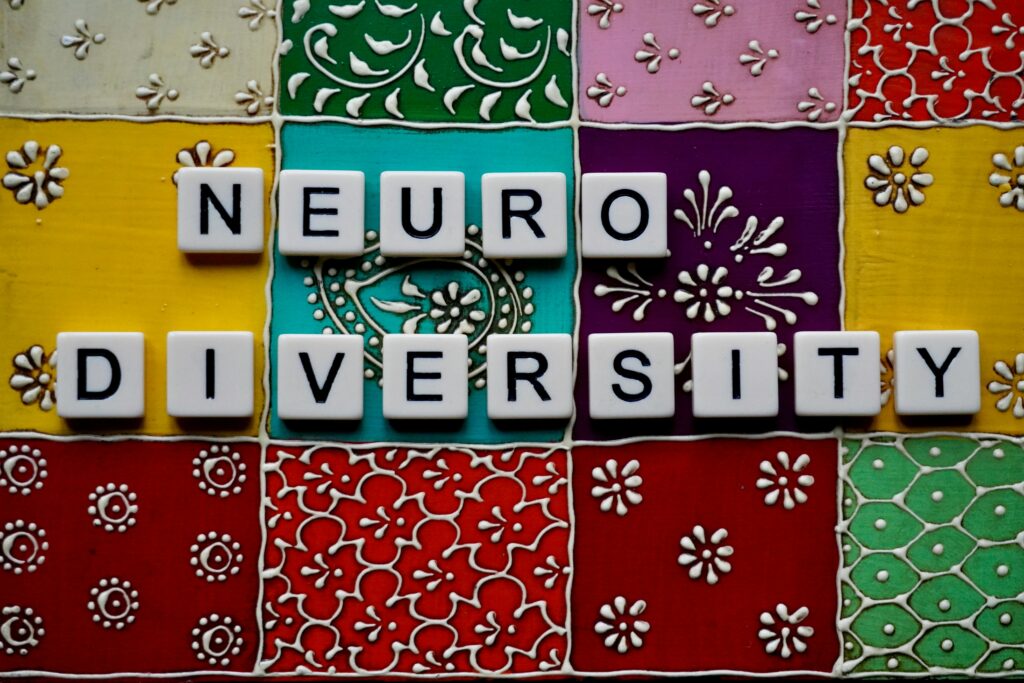
For many people, discovering they’re neurodivergent later in life can be both a relief and an emotional turning point. In this blog, Solution Focused Hypnotherapist Madi Kish shares her own lived experience alongside her professional insights to explore what neurodiversity really means, why neurodiversity and mental health are so closely linked, and how Solution Focused Hypnotherapy can help people better understand and work with their unique brains.
Seeing Things Differently
It’s a strange feeling: the slow realisation that actually, yes, something is different, and no, you’re not just ‘not coping very well’.
For me, that moment came about halfway through the Covid pandemic. I was living alone in a teeny-tiny studio flat, trying to manage teaching long division to my Year 6 class via Teams, dealing with the fallout from a bad breakup, and learning how to navigate the ‘new normal’ of the world.
None of the coping techniques in my mental health toolbox were working any more, I was having regular meltdowns and TikTok kept (not-so) subtly suggesting that the symptoms I was noticing were common for someone with ADHD. When I finally suggested to my friends and family that an ADHD diagnosis might make sense of my experience, no one was particularly surprised!
I’m one of the many people who reached adulthood before receiving a diagnosis, or self-identifying, as neurodivergent — and these numbers are steadily increasing.
What Is Neurodiversity?
So, what do I even mean by labelling myself as ‘neurodivergent’?
The word itself is used a lot today and is generally understood to describe someone who is autistic, has ADHD, or both. But did you know there is a whole range of conditions that can fall under the neurodivergent umbrella?
First, I want to clarify the difference between the words neurodiversity, neurodivergent and neurotypical.
- Neurodiversity essentially means a difference between brains (neuro = brain/nervous system and diversity = the condition of being different). As humans, we are all neurodiverse. Our brains and nervous systems are as unique as our fingerprints (although, of course, there are similarities in how our brains work).
- Neurodivergent means that a person’s brain differs or diverges from what is considered the norm. This may be due to a condition such as autism or ADHD, but it can also stem from certain mental health conditions or acquired brain differences.
- Neurotypical means, as you’ve probably guessed, a person whose brain is considered ‘typical’ — the standard from which one can diverge. There is an argument that no one truly has a completely neurotypical brain because we are all different, but the term generally refers to people whose thinking and behaviour align with what is considered typical for most people.
For more, the National Autistic Society has helpful guidance on autism and neurodiversity.
Neurodiversity and Mental Health: Why They’re So Closely Linked
Many people who are neurodivergent will have experienced the same scenario: you go to the doctor because things don’t feel quite right, and you want to explore whether you might be autistic or have ADHD… and instead, you receive a diagnosis of anxiety.
While this might not be the result you expected, there’s a reason so many undiagnosed neurodivergent people have this experience when seeking support. It doesn’t necessarily mean you aren’t neurodivergent, or that the anxiety diagnosis is wrong. Rather, there are many overlapping traits and experiences to consider.
Research has shown that 47% of autistic people experience severe anxiety using the GAD diagnostic criteria, while 59% say anxiety has a significant impact on their lives. Source: National Autistic Society, anxiety and autism.
Being neurodivergent doesn’t automatically mean you will experience anxiety, depression or other mental health conditions, but you are more likely to experience them due to a range of different factors.
If you are neurodivergent, you’re likely to encounter more stress-inducing situations in everyday life. For some people, this may be changes in routine, navigating social situations, or mentally rehearsing conversations in order to appear ‘appropriate’. For others, it could be sensory overwhelm or simply living in a world that doesn’t accommodate their needs.
If you are constantly needing to explain yourself, or mask to adapt to situations that make you uncomfortable, it makes perfect sense that, over time, your mental wellbeing can begin to suffer.
How Can Solution Focused Hypnotherapy Help?
When it comes to neurodiversity and mental health, the approach doesn’t fundamentally change. At Inspired To Change, we work with neurodivergent clients in much the same way that we work with neurotypical clients, because, ultimately, it’s all about the brain.
Regardless of your neurotype, we all have a primitive part of the brain and an amygdala whose job is to protect us from harm. When it perceives danger, it responds with emotions such as anxiety, anger or low mood — primitive responses designed to keep us safe. At the same time, we all have an incredible intellectual resource that can generate positive, rational and creative solutions to life’s challenges.
It’s in the small details where things begin to change.
Each session explores a different aspect of understanding how the brain works, and as therapists we personalise this to suit exactly what each client needs. For our neurodivergent clients, that might mean explaining differences in dopamine production, exploring the impact of long-term masking, or understanding how stress builds up differently for you.
Two Phones, Two Operating Systems
One of our therapists, Claire Noyelle (Inspired To Change Maidstone), uses a brilliant metaphor to explain the difference between a neurotypical and a neurodivergent brain.
Imagine two phones: one is an Apple device and the other is Android. Both work well. Both do exactly what phones are designed to do. But if you try to download an Apple app onto an Android phone, it simply won’t work — and the same is true the other way around.
So, if you’ve spent your life trying to use strategies and tools that weren’t designed for the way your brain works, it’s no wonder they haven’t always helped. It’s not because one brain is better than another. They’re simply different, and different brains need different kinds of support.
If you’ve lived in a world where you’ve constantly been trying to run apps designed for a completely different operating system, it’s easy to begin believing you’re not good enough or that you’re somehow not trying hard enough.
Working With Your Brain, Not Against It
When it comes to neurodiversity and mental health, Solution Focused Hypnotherapy can help you better understand and work with your brain, rather than against it. It can build confidence, reduce overwhelm, and help you advocate for yourself, so you can become the authentic version of yourself that you deserve to be.
If you’re ready to take that next step, you can book a free consultation with one of our hypnotherapists today.
About the Author
Madi Kish is based in Tunbridge Wells and she works primarily with adults experiencing anxiety, overwhelm and low confidence, including many who identify as neurodivergent or are exploring a late diagnosis — an area Madi is particularly passionate about through both her professional work and her own lived experience with ADHD and autism.ADHD and autism.